
With cotton still figuring in the list of commodities that are produced using practices such as child labour, the Confederation of Indian Textile Industry (CITI) has entered into an understanding with the International Labour Organisation (ILO) to create awareness, share technical know-how and knowledge about better labour standards. These standards, which are part of ILO Fundamental Principles and Rights to Work (FPRW), will be tried on a pilot basis in major cotton-growing districts of Madhya Pradesh for one year starting in 2024.

The Ministry of Statistics and Programme Implementation (Mospi) has started preparations for the eighth Economic Census (EC), which is expected to be formally launched next year, sources told Business Standard, even as the results of the seventh edition are yet to be made public. "Centre has asked states and Union Territories (UTs) to submit requirements for funds and manpower in a bid to start work on the eighth EC. "The states and UTs are required to set up a dedicated unit to conduct the exercise.

'Given our turbulent neighbourhood, the prime minister is likely to emphasise on democratic dividend as the reason behind India's continuous prosperity.'

After climbing to the highest level in more than five years to 4.7 million tonnes in FY24, India might import fewer quantities of pulses this financial year at 4-4.5 mt on the back of good monsoon and higher domestic production, Bimal Kothari, chairman of India Pulses and Grains Association (IPGA), said in New Delhi on Friday. Kothari was addressing reporters on the sidelines of a seminar on pulses titled "Bharat Dalhan-2024".

In what could come as a piece of good news, hunger in India - as measured by the Prevalence of Undernourishment (PoU) by the United Nation's Food and Agriculture Organisation (FAO) - has come down from 16.6 per cent of the population in the 2020-2022 to 13.7 per cent in 2021-23, the latest report on the State of Food Security and Nutrition in the World (SOFI 2024) showed. This means that around 39.3 million people have come out of undernourishment between the two periods, NITI Aayog member Ramesh Chand said on Tuesday.

Recognising job creation for the youth as the foremost challenge for the economy, Finance Minister Nirmala Sitharaman on Tuesday announced a comprehensive Prime Minister's package to facilitate the employment and skilling of 41 million youth with a central outlay of Rs 2 trillion over the next five-year period. The package will consist of five schemes and initiatives - three focused on jobs and two on skilling.

'This year overall hiring has seen a slight improvement as compared to the dip seen during the last financial year.'

Several BJP-backed state governments have unveiled schemes targeting the poor, women, farmers and students, following the party's setback in the Lok Sabha polls.

Alloting more funds for MNREGA and PM-KISAN could wipe out the entire additional money that the Centre may have for FY25.

Milk supplies could improve with the monsoon, provided the rains are not excessive.

As a panel of senior ministers deliberates on the need to review curbs on exports of some rice varieties, data shows that since outbound shipments saw restrictions in July-August last year, the non-basmati segment has suffered more than basmati exports. Sources said the panel is expected to soon deliberate on a few suggestions to ease the export curbs on some rice varieties due to higher-than-required stocks in the central pool. The panel, some observers feel, may also postpone the decision to ease the export curbs till a firm picture emerges on the latest kharif paddy sowing.

'There is no immediate threat to the government, and they would prefer the growth agenda.'

Updated new base years for national accounts and other macro-indicators are expected to come into effect from January-February 2026, coinciding with the first and second advance estimates of national income for FY26, senior official sources aware of the development told Business Standard. "The statistics ministry set up the Advisory Committee on National Accounts Statistics (ACNAS) earlier this week. "It will advise on the base year for GDP (gross domestic product) and its alignment with other macro-indicators.

A company spokesperson told Business Standard that Amazon was committed to the safety and well-being of its employees. "Disciplinary proceedings have been initiated against the people involved in the incident. "The process is underway and we are looking at a potential case of 'separation' for the people involved within the next week or two," the spokesperson added.
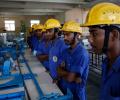
Unincorporated enterprises in the manufacturing sector lost nearly 1.8 million establishments and shed 5.4 million jobs between July 2015-June 2016 and October 2022-September 2023, an analysis of the fact sheet on 'Annual Survey of Unincorporated Sector Enterprises (ASUSE)' and the comparable 73rd round survey in 2015-16 by the National Statistical Office (NSO) showed. An estimated 17.82 million unincorporated enterprises operated in the manufacturing sector in October 2022-September 2023, nearly 9.3 per cent down from 19.7 million unincorporated enterprises in July 2015- June 2016.

The number of fresh formal jobs generated in a month increased to a seven-month high in April, signalling a recovery in the formal labour market in the country, according to the latest monthly payroll data released by the Employees' Provident Fund Organisation (EPFO) on Thursday. In April, the number of new monthly subscribers under the Employees' Provident Fund (EPF) sequentially increased by 18.77 per cent to 887,438 from 747,146 in March.
'Efforts are on to make the data readily available so that it proves useful for policymakers.'

After adding 11.7 million workers in the October 2022-September 2023 period from the pandemic lows in April 2021-March 2022, total workers employed in the vast informal sector in India - at 109.6 million - still remains below the pre-pandemic period.

Increased production of pulses, oilseeds, and cereals will help boost domestic supplies and contribute to keeping inflation low in the coming months.
'The expeditious enactment of labour codes and strategic measures to bridge the skills jobs gap are critical.'
 © 2025 Rediff.com - Investor Information - Advertise with us - Disclaimer - Privacy Policy - Sitemap - Feedback - About us - Terms of use - Grievances